
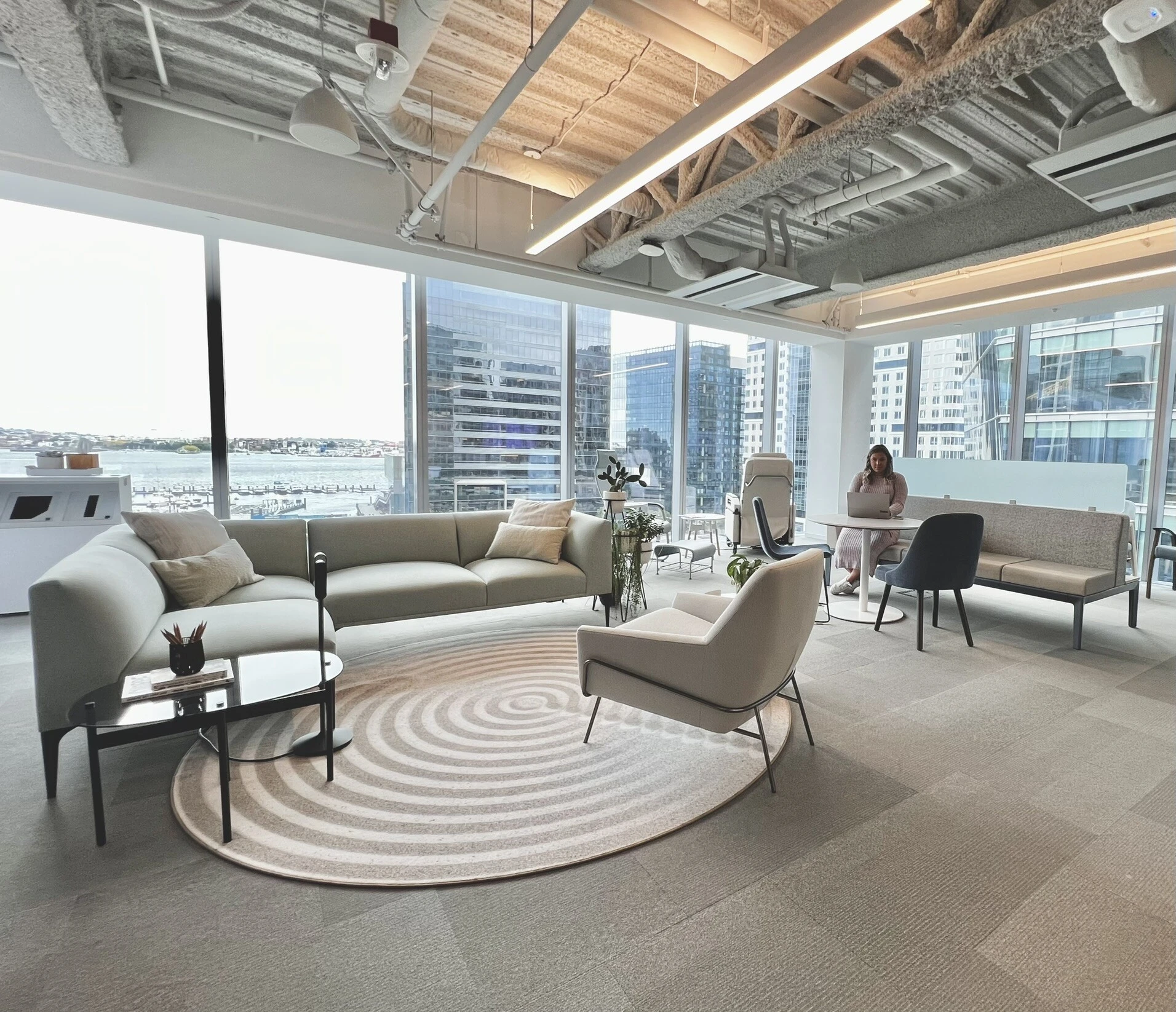
What the Resurgence of Craft Reveals about Human-Centered Workplace Design
Written by Jess Klay
From quilting and ceramics to visible joinery and honest materials, craft is having a cultural resurgence. In this thought leadership piece, Red Thread’s Jess Klay explores why people are drawn to making things by hand and what that desire for process, quality and human touch can teach us about designing workplaces in an increasingly automated world.
In this article, she explores:
- Why craft is resonating in an increasingly digital world
- How sensory details and materiality shape the workplace experience
- Where craftsmanship, technology and human-centered design intersect
- What these shifts could mean for the future of workplace design
This week, my daughter Cece leaves for her junior year of college.
Like many parents, I find these transitions bittersweet. I am proud of the person she is becoming, while also acutely aware that each departure brings her closer to a life and career of her own.
Cece is Gen Z. She is not simply preparing to enter the workforce. She represents its future. Recently, she started quilting. And I’m fascinated.
Made Slowly, Valued Deeply

Here is someone who has grown up with technology woven into nearly every part of her life, yet she is drawn to an art form built on patience, repetition and touch.
I helped her set up her space with a folding table, a comfy chair, and positioned right in front of a large window overlooking the backyard.
Quilting cannot be rushed. It requires you to select individual pieces, consider how they relate to one another, and slowly assemble them into something larger. She started drawing it out with colored pencils on drafting paper. Then hand-picked the fabrics and materials in stores. Took close up pictures, moved them into an app to refine her concept. Then she went to work.
Cece is not alone. Quilting, knitting, needlepoint, ceramics, woodworking, sourdough and other traditional forms of making are finding new audiences, particularly among Gen Z and millennials seeking opportunities to unplug, create and connect with others. According to the U.S. Chamber of Commerce, this renewed interest in craft is being driven partly by younger generations looking for relief from digital saturation and a return to more tangible experiences.
This is more than nostalgia. I believe it reflects a larger recalibration. And I’m here for it.
Technology continues to make our lives faster, smoother and more automated. AI can eliminate steps, accelerate processes and help us accomplish things that once required hours of effort. I use it in my own work every day, constantly looking for outdated processes that can be improved. Heck, it’s helping me proofread this article.
But greater efficiency does not eliminate our need for effort, creativity or connection. The real thinking behind it all. It actually makes those experiences more valuable. Curiously, in a world designed to conceal the process, we are becoming increasingly interested in the seams.
Exposing the Seams
During my recent visit to Kimball International, I was introduced to its 2026 workplace trends podcast called “Alternative Conversations.” This episode called “Exposing the Seams” explores a growing appreciation for craft, process and material integrity, as well as the design community’s role in carrying these values forward. It also ties in nicely to their Furnishing the Future Trends Report’s design expression of embracing visible process and material honesty, revealing how things are made rather than hiding construction details.
Instead of disguising every joint, stitch or irregularity, designers are allowing process and craftsmanship to become part of the experience.
It immediately brought me back to Cece and her desire to quilt.
A quilt derives its value from more than its pattern. Its meaning comes from the many decisions embedded within it: the fabrics chosen, the time invested, the imperfect stitches and the hands that assembled it.
The same can be true of a workplace.
For years, many offices pursued an almost frictionless visual consistency. Furniture matched. Surfaces were flawless. (Remember all that white laminate everywhere?)
Spaces could look highly polished but also strangely interchangeable.
Material honesty offers a different approach. Wood can show its grain. Textiles can have depth and variation. Connections can be expressed rather than hidden. Reclaimed, locally produced and custom elements can reveal something about the people, place or industry behind the environment.
This does not mean a workplace should feel unfinished. It means its refinement does not need to erase its humanity.
Craft Is More Than an Aesthetic
The importance of craft extends beyond appearance. It also connects to the emerging field of neuroaesthetics, which considers how the brain and body respond to art, beauty, materials and other sensory qualities in an environment.
We do not experience a workplace through vision alone. We respond to texture, light, sound, form, color and materiality. A room can make us feel stimulated, grounded, curious, comfortable or depleted before we consciously understand why.
That makes tactile and sensory design more than decoration.
A woven textile can soften both the visual and acoustic experience of a room. Natural variation can provide relief from rigid repetition. Curved forms may feel more approachable than an environment dominated by sharp edges. Wood, wool, stone and other tactile materials can offer a sense of warmth and grounding. And yes, let’s not forget the biophillia.
Neuroaesthetics does not provide a universal formula for making everyone feel or perform the same way. Human responses are far too individual for that. It does, however, reinforce an important idea: the aesthetic and sensory character of a space can influence how people experience it.
This is especially relevant as we consider neurodiversity and the needs of the next generation. The future workplace cannot be designed around one ideal employee, one sensory profile or one prescribed way of working. Some people need energy and stimulation. Others need visual quiet, acoustic control or a place to retreat and reset.
The goal is not to create one perfect environment. It is to create an ecosystem of experiences that gives people meaningful choice.
Designing for a Generation Raised Online
Cece’s generation has lived much of its life through screens. Members of Gen Z can move seamlessly between physical and digital worlds, but that does not mean the physical world matters less to them.
Their interest in handmade objects, vintage furnishings, natural materials and visible process suggests almost the opposite.
Who made this? Where did it come from? What’s the story? Can I see myself in it?
These questions matter when we design workplaces intended to attract and support emerging talent.
The next generation does not need the office to compete with technology. They need it to provide what technology cannot fully replicate: sensory richness, spontaneous connection, shared rituals, physical experimentation, belonging and a tangible relationship to organizational culture.
Technology should make the workplace easier to use. It should help people connect, create and accomplish their work. But it should not become the entire experience.
The Opportunity for Workplace Leaders
The resurgence of craft offers several lessons for workplace leaders. Amanda Schneider just wrote a great book on it (even Oprah is talking about it).
First, efficiency is not the only measure of value. A workplace also needs to support identity, pride, curiosity and connection.
Second, consistency should not come at the expense of character. Furniture and materials should be evaluated not only for how they look together, but for how they feel, age, perform and communicate care.
Third, people need to see themselves reflected in their environment. That requires listening to employees across roles, generations, work styles and sensory needs rather than designing around assumptions.
Finally, technology and humanity should not be positioned as opposing forces. The opportunity is to use technology to remove unnecessary friction while preserving the tactile, social and creative experiences that make work meaningful.
When Workplace Consultants are engaged early and leveraged fully, we can help organizations connect workplace strategy, furniture, technology, acoustics and architectural systems into one cohesive experience. Oftentimes, the conversation goes beyond what products clients should purchase to what their people and culture actually need from the workplace.
The real work lies in connecting every piece. You might even say there’s a thread running through it all.
The Value Is in the Making
I do not know what Cece’s first quilt will look like. Although it’s coming along quite nicely. The pieces may not align perfectly. She may change her mind halfway through or discover that the process is far more difficult than she expected.
That will not diminish its value. Its value will come from the time she gives it, the choices she makes and the fact that no one else could produce exactly the same quilt.
As she leaves for college and moves closer to becoming part of our workforce, I keep thinking about what her generation will need from the places we create.
They will need advanced technology, certainly. But they will also need environments with texture, personality and purpose. They will need spaces that recognize different ways of thinking and working. They will need places where culture feels tangible and where human contribution remains visible.
The future workplace should not conceal every seam. It should reveal the care, collaboration and individual decisions that brought it to life.
That is what will make it worth coming to.
Many thanks,
Jess

Jessica Klay
Workplace Consultant
Red Thread
774.364.0833
jklay@red-thread.com
With more than 20 years of experience, Jess brings a thoughtful, consultative approach to helping organizations connect people, culture, and space. Having led global brand experiences and workplace transformations for Workhuman, Monster Worldwide, and Bose Corporation, she draws on first-hand client-side experience to understand each organization’s unique challenges and opportunities, partnering closely with clients to develop solutions that are both strategic and human-centered.
Jess joined Red Thread because of a shared belief that the workplace is more than a physical space; it’s a powerful tool for connection, engagement, and growth. She specializes in workplace strategy, employee experience, and innovation at the intersection of real estate and technology.


