
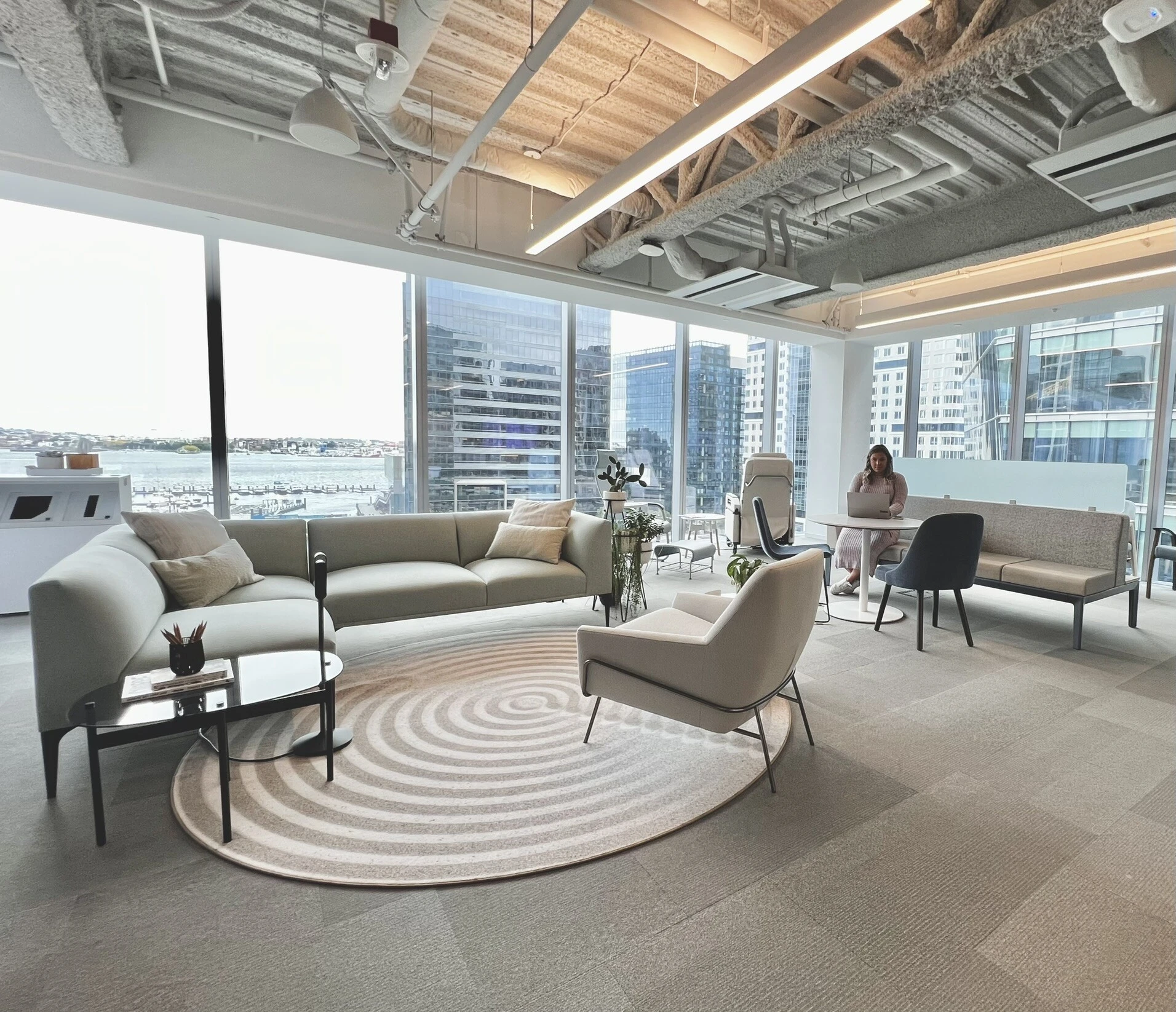
Explore how modular wall systems helped shape a flexible, high performance headquarters in Boston.
When a workplace spans 11 floors and more than 250,000 square feet, every design decision carries weight. For this confidential global financial services firm, the goal was not only to create a workplace that reflected the sophistication of their brand, but one that could evolve alongside the future of their business.
That flexibility became especially important when planning enclosed spaces throughout the headquarters. Private offices, conference rooms, huddle spaces, and collaborative areas all needed to support performance, privacy, and adaptability without sacrificing openness or access to natural light.
Modular wall systems played a critical role in bringing that vision to life.
We sat down with Bill McCarthy, Director of Architectural Products Sales at Red Thread, to talk about the strategy behind the project, the growing role of modular walls in today’s workplace, and why flexibility has become one of the most valuable design considerations organizations can make.
Where does wall strategy actually enter the conversation on a project like this?
Bill: Earlier than most people expect. Walls are one of the first tools used to define how a space will function — they influence circulation, set expectations around privacy, and establish the overall feel before much else is decided. Bringing that thinking in early means walls become part of the planning strategy rather than a finishing element, which allows teams to shape the experience from the outset rather than reacting to decisions that have already been made.
What was the overall design direction, and how did you approach the wall strategy?
Bill: The goal was a space that felt open and architectural without sacrificing real performance. That meant balancing visual openness with acoustic control — and a combination of systems from Steelcase and PurOptima delivered on both.

Left: PurOptima | Right: Steelcase
Rather than defaulting to a single solution across the entire floor plate, we looked at what each system does best and applied them accordingly. The result is a space that feels cohesive but is actually doing a lot of different things depending on where you are.
Where did Steelcase Lite Scale fit into the project?
Bill: Lite Scale was the right choice where acoustic performance was the priority. The system’s ability to start with single glazing and upgrade to double glazing over time gives it a flexibility that’s hard to match — you’re not locked into a performance level at install. The minimal, glass-forward aesthetic also meant it didn’t feel like a compromise to get that performance.
Sightlines stayed open, light moved freely, and the butt-joint glazing kept the look clean and continuous rather than segmented. In spaces where people need to focus or where sound control really matters, Lite Scale gave us the confidence that the performance would be there.
And where did PurOptima come in?
Bill: PurOptima played a big role in setting the architectural tone of the space. The system’s slim profiles and consistent detailing helped establish a refined, minimal look throughout, while the glass applications allowed daylight to carry deeper into the floor plate.
It’s a system that reads as very intentional — the kind of thing that elevates the overall aesthetic rather than just defining square footage. For areas where the visual experience was the driving consideration, PurOptima delivered that cleanly and consistently.
Why are clients drawn to glass-front systems right now?
Bill: A lot of it is about what people want their workplaces to say. There’s a real shift away from closed, compartmentalized offices toward spaces that feel lighter and more connected. Glass-front systems deliver that in a very intentional way — the slim profiles and continuous glass lines create a more refined look than traditional construction typically achieves.
But clients aren’t giving up defined space to get there. You still have private, enclosed areas, they just feel connected to the broader environment because the visual language stays consistent. That balance is a big part of the appeal.
How do you guide the decision between where to be open and where to pull back?
Bill: We try not to treat openness and privacy as competing ideas. Glass-front spaces maintain connection and let light move through the floor plate. Enclosed areas give people separation when the work calls for it. The goal is to layer both so the space supports a range of work styles without feeling exposed in some places and closed off in others.
The wall strategy really has to follow function. A focus room needs to perform differently than a collaboration space or a main corridor. Aligning the right system with how each area is actually used makes the whole thing feel cohesive.
Was there a moment in this project where everything really came together?
Bill: It usually happens when the glass goes in and the space opens up visually. Sightlines extend, natural light moves freely, and the balance between openness and enclosure becomes real rather than something on a plan. What stood out on this project was that the acoustic performance also exceeded expectations at that point, even better than the initial mockups suggested. It’s a good reminder that the products perform even better once they’re fully installed in the actual environment than they do in early testing.
How did installation factor into keeping the project on track?
Bill: Delivery and installation were phased two floors at a time, which kept things organized and minimized disruption to other trades. It created a steadier workflow, made coordination with the GC more manageable, and allowed for better quality control throughout.
That predictability is one of the underappreciated advantages of demountable systems. Compared to traditional construction, the process is cleaner, faster, and easier to plan around. That efficiency shows up both in the schedule and in reduced construction waste on site.
How do these systems hold up as needs evolve?
Bill: That’s where the real value becomes clear over time. Both Steelcase and PurOptima are designed with reconfigurability in mind. Panels can be reused, layouts can be adjusted, and changes can happen without tearing into surrounding construction. With Lite Scale specifically, there’s also the option to upgrade glazing performance in place if acoustic needs increase down the line. You’re not starting over; you’re building on what’s already there. That kind of adaptability protects the original investment and keeps the space relevant as the organization evolves.
What’s the biggest misconception you run into with modular wall systems?
Bill: There’s still a perception in the industry that modular walls involve some kind of trade-off — that choosing flexibility means giving something up in design or cost. But systems from Steelcase and PurOptima consistently prove otherwise. They deliver high-end design and strong acoustic performance, and they’re often more cost-effective over the life of a space than traditional construction. When you factor in faster installation, less construction waste, and the ability to reconfigure rather than rebuild, the value compounds over time in a way that drywall simply can’t match. It’s a smarter investment from day one, and it only gets more valuable as the space evolves.


