
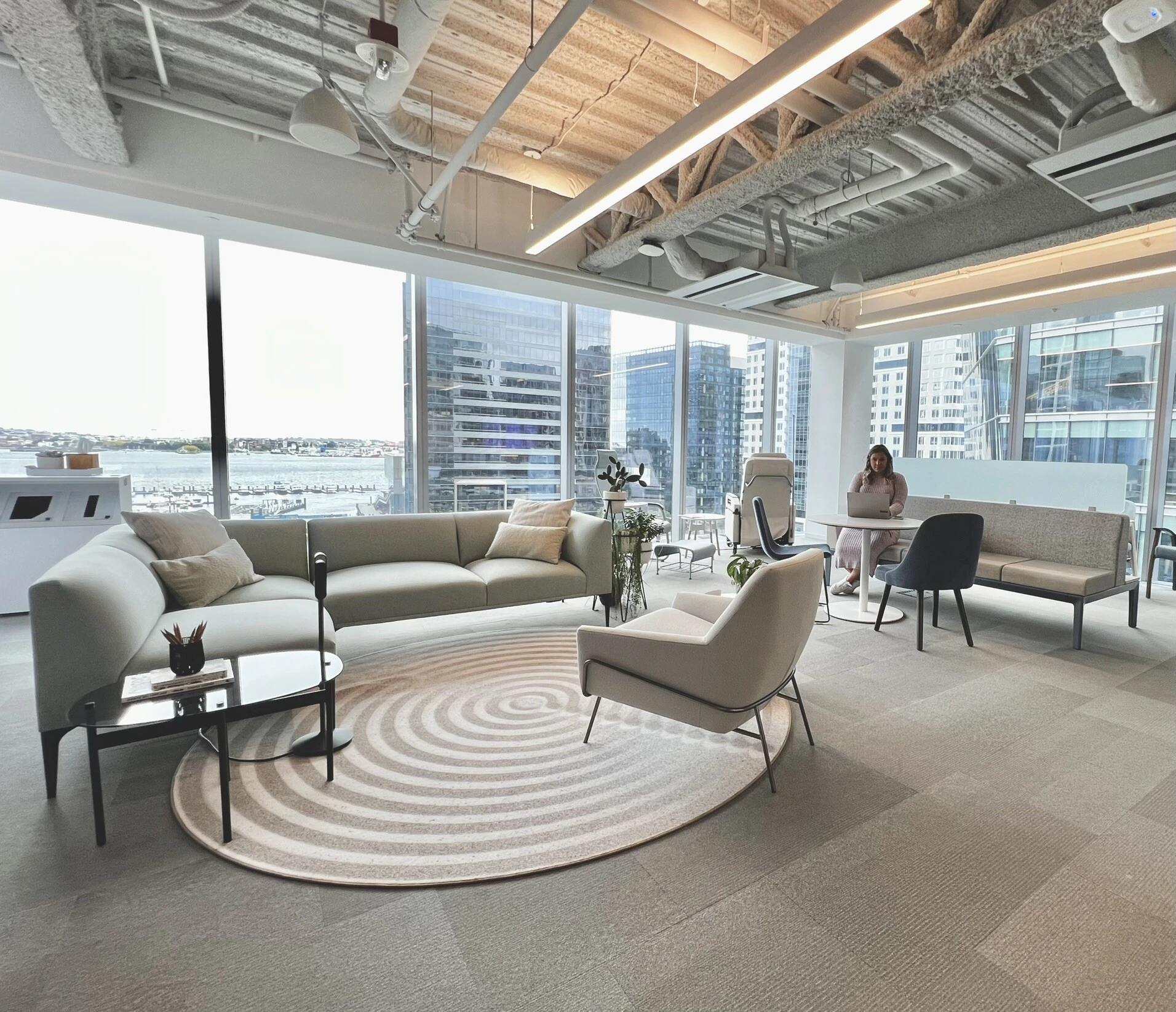
How 2027 Workplace Color Trends Are Shaping Office Design
Written by Jess Klay
From nature-inspired greens to tactile fabrics and warm wood tones, workplace palettes are gaining depth and personality. In this thought leadership piece, Red Thread’s Jess Klay explores 2027 workplace color trends and how color, natural materials and layered textures come together to create more inviting spaces.
In this article, she explores:
- How learning takes shape in classrooms and beyond
- How 2027 workplace color trends draw inspiration from nature
- Why familiar colors carry personal meaning
- How natural materials and layered textures create warmth
- What makes an office feel inviting and memorable
As workplace design continues to embrace warmer colors, natural materials and layered textures, these same qualities are shaping how we think about the spaces where we work. From nature-inspired color palettes to tactile furnishings, the workplace is becoming a place where comfort and personality matter as much as function.
Finding Inspiration in the Everyday
This past Sunday, my husband and I went for a walk.
It was one of those beautiful New England fall days when you find yourself paying closer attention to everything around you. The leaves, of course, but what caught my eye most wasn’t the brilliant foliage.
It was the quieter stuff.
The pale lichen growing across a rock. The deep green moss along the water. The olive, rust, charcoal and almost-black surfaces underneath it. The sunlight hitting the stream and turning the water amber.
I kept stopping to take pictures.

What struck me later was how layered it all was. Nothing matched perfectly. Nothing felt overly coordinated. There were hundreds of shades of green, brown and gray sitting next to each other, softened by texture, water and light.
And somehow, it all worked.
Maybe nature has been making the best material palettes all along.
Finding Comfort in Nature-Inspired Colors
A few days later, I started looking at the newly announced 2027 Colors of the Year, and there was that green again.
Benjamin Moore selected Webster Green HC-130, a confident mid-tone green intended to feel both rooted and current. Behr selected Grounded, an earthy olive that moves between moss and brown. And Sherwin-Williams selected Celery, a much lighter herbal green designed around ideas of comfort, clarity and restoration.
Three very different greens, but I see a common thread.
They don’t feel artificial. They feel familiar.
Benjamin Moore’s broader 2027 palette follows a similar direction, combining softened neutrals, browns, ochres, pinks and blues with Webster Green. The company describes the collection as warm and welcoming, drawing inspiration from colors appearing across design and other creative disciplines.
For me, that is much more interesting than declaring that green is suddenly “in.”
Green never really left.
It’s moss. Pine. Herbs. Lichen. Fields. Water. The first signs of spring and some of the last colors hanging around before winter.
These colors already mean something to us.
From Color to Material: The Power of Texture
I recently walked through a trade show and saw the story continue.
There were rich greens, dusty blues, ochres, clay colors and deeply textured textiles everywhere. One of the collections I kept coming back to was Kelly Wearstler’s work with Lee Jofa.
Her 2026 Tela collection begins with nature, interpreting things like shifting sand, layered stone and wind-shaped surfaces through textiles rather than literally reproducing them.
That distinction matters.
Biophilic workplace design doesn’t have to mean putting a plant in the corner or covering a wall with leaves. Nature can show up through irregularity. Through texture. Through colors that shift rather than match. Through surfaces that invite you to touch them.
I was particularly drawn to an olive textile against a blue woodgrain surface. Neither color was especially loud, but together they had incredible depth.
It reminded me of the photographs from our walk.
Even Workplace Power Is Getting Dressed Up
A few tables away, Byrne was doing something completely different, but strangely connected.
Power.
Yes, power.
The thing we have traditionally tried very hard to hide underneath a conference table is suddenly showing up in sculptural forms, unexpected colors and finishes designed to become part of the composition.
Byrne has actually framed its Fall 2026 collection around a “Fashion Forward” idea, arguing that workplace power no longer needs to disappear into the background. Their newest products are being treated more like designed objects, with new silhouettes, finishes and material expressions.
I love that.
Because why shouldn’t something functional also contribute to how a space feels?
We’re spending far too much time in our workplaces for everything around us to be purely utilitarian.
Then I Found a Book About Color
Later, back in our showroom, I happened upon a book sitting on a table: The Secret Lives of Color by Kassia St. Clair.
Perfect timing.
The book explores the histories and cultural stories behind individual colors, looking at how pigments and shades have intersected with art, politics, fashion and everyday life.
And it made me think about how rarely color is actually neutral.
A color can remind us of our grandmother’s kitchen. A childhood bedroom. A favorite sweater. A trip. A season. A landscape.
We bring all of those associations into a space with us.
Which is why designing with color isn’t simply about choosing something that photographs well or aligns with whatever is trending this year.
It’s about creating a feeling.
Creating Warmth Through Color, Texture and Materials
This is where I think workplace design gets interesting.
For years, many offices leaned heavily toward white, gray and neutral palettes. They were clean. They were flexible. They were safe.
But safe can also become forgettable.
Creating warmth doesn’t mean every workplace suddenly needs an olive-green wall.
It might be the depth of a velvet upholstery. A warm wood tone against a saturated blue. A textured fabric that catches the light differently throughout the day. A deep burgundy chair against a quiet neutral backdrop. A power unit that becomes a tiny unexpected pop of red.
It is the layering that creates the experience.
We’ve seen that play out in Red Thread projects in very different ways.
In a 1920s-inspired multitenant property, rich jewel tones, velvet upholstery, curved forms and vintage references create character without turning the space into a theme.
At a confidential investment firm’s Boston headquarters, layered colors, materials and unexpected details give six themed floors distinct personalities while keeping the workplace cohesive.
The palettes may be different, but the principle is the same.
The most memorable spaces aren’t created by one great color.
They’re created by relationships between color, texture, material, light and the people experiencing them.
Designing Workplaces for How We Feel
I started this week photographing moss on a rock.
I ended it looking at textile samples, brightly colored power units and a book about the hidden stories behind color.
Maybe that is why this year’s color forecasts feel less like predictions to me and more like reminders.
Our environments don’t need to shout to have personality.
They can be nuanced. Layered. Imperfect. Familiar.
And while colors will continue to come in and out of fashion, I don’t think our desire to feel comfortable, connected and inspired by the places around us is going anywhere.
Perhaps the question isn’t: what color is next?
It’s: how do we want people to feel when they walk into the room?
That’s a much more interesting place to begin.
Many thanks,
Jess

Jessica Klay
Workplace Consultant
Red Thread
774.364.0833
jklay@red-thread.com
With more than 20 years of experience, Jess brings a thoughtful, consultative approach to helping organizations connect people, culture, and space. Having led global brand experiences and workplace transformations for Workhuman, Monster Worldwide, and Bose Corporation, she draws on first-hand client-side experience to understand each organization’s unique challenges and opportunities, partnering closely with clients to develop solutions that are both strategic and human-centered.
Jess joined Red Thread because of a shared belief that the workplace is more than a physical space; it’s a powerful tool for connection, engagement, and growth. She specializes in workplace strategy, employee experience, and innovation at the intersection of real estate and technology.


